Monday, November 19, 2012

The Cacodylic Eye


Francis Picabia became a leading name in the Paris Dada movement with his mechanomorphic paintings, which were considered explosive in subject when he submitted them to exhibitions.  He collaborated with The Zurich Dadaists, working on publications of the Dada by Tristan Tzara. 


Given credit under Picabia, L'oeil cacodylate stands as a radical portrait of collaborative efforts representing multiple artists linked to the Dada movement.  There is not one singular author, technique, or medium used throughout the whole piece.  The variety sheds light on one of the key ideas of Dada: Chance.  Those who had come to visit Picabia while he recovered from eye surgery were presented with this paper covered in euphemisms, collage efforts, small phrases, photomontage, and signatures.  It was considered finished when Picabia saw there was no room left at all for any additions.


Dada is a movement that has affected the arts in the modern age.  With this being said I believe it is essential to find links in some practical exercises I have experienced, and the Dada techniques.  The moment I saw L’oeil Cacodylate I was brought back to an event I attended in 2011 on Earth Day put on by TOMS shoes that had three huge canvases set up and buckets of primary colored paint sitting at the bottom of each.  People from all over the world began to paint letters, add ticket stubs, write phrases, and leave their imprint on this canvas.  There were no rules or directions to follow besides just simply create.   There were multiple events across the United States that had this exact same purpose, to just create together.  I knew no one that painted on the same canvas as I, and although the Dadaists did collaborate together throughout the movement and exchange information worldwide, I am sure there are those who worked on Picabia’s L’oeil Cacodylate who did not know each other.


The beauty of a group composition with such endless possibilities is something that has come from the Dada movement.  L'oeil Cacodylate may not be the most aesthetically pleasing composition to view at an exhibition, but it has a uniqueness that wards great aesthetic pleasure to a viewer.


The fact is that there was no outside guidance for the way these pieces of art should be completed.  The composition was free for the visitor to work with; Chance.


Friday, November 16, 2012

The Written Word


Although the Dadaists were not the first to direct their movement through a manifesto, they approached the type of political output of text as a means of self-reflection of the movement.  By creating these manifestos that stated what they as artists were about it left no room for extreme criticism.  Rather, they created a whole new platform for the art critics to respond to the pieces and exhibitions. Unlike the other art manifestos that were written in avant-garde movements, the Dada artists wrote multiple versions.  Different artists composed their own version of the manifesto, and others wrote multiple forms. 

Along with the manifestos, came journals.  These journals were especially prominent in the Dada movement.  The beginnings of mass communication were being unleashed and artists took this new format as an opportunity to showcase different techniques.   Within these journals, different manifestos were published, presenting themselves to the reader. 

Dada journals were the first of its kind to utilize the platform for the source of main interaction.  Throughout Europe different journals were published, giving way to international exchange of the movement.  Journals came out of the Netherlands, produced by Theo van Doesburg, and in Yugoslavia, Dragan Aleksić produced the Yugo-Dada magazine. In the main centers where Dadaism was formulated, like Paris, New York, and Zurich, you see the same production as well.  Although they were separately located, the Dada artists communicated extensively, sharing ideas, art, and formats.

The journals were not simply like a magazine seen today, but they were a new technique of art that was carefully planned out and structured.  From the front cover to the last page they were carefully composed.  The thought that went in to each edition did not mean that they were simple for the reader to understand though.  The new use of typography made the page more complex, where the reader may be turning the page around and around just to read every word written on it.  The words were also meant to be nonsensical, and disorderly on the page. 

The Blind Man, a journal set up by Marcel Duchamp, Henri-Pierre Roché, and Beatrice Wood, was set up precisely to commentate on the Independents Artists Exhibition of 1917.  In the first edition the creators made a call for responses to the exhibition pieces by writing:

Write about the Indeps, or about any special work in the Exhibition.

A dramatic story of less than one hundred words.

A comic story of less than one hundred words.

A dream story of less than one hundred words.

A quatrain, or a limerick
A song (words and music)
-Roché

By putting this call in the journal, he takes away the art critic’s job, similar to the manifestos doing. Choosing two different options from above I responded to the call, not focusing on the Exhibition, but rather two pieces from the Dada artists that spoke to me. 

A dream story:
Bicycle Wheel – Marcel Duchamp

Spinning, staring, spinning, staring
Lost in the lines
The cold metals lines
Through them light shines
Staring, Spinning, Staring
The shining light comes faster, closer, faster
It pulls you in.  Taking you over
The light consumes
Coldness covers as the spinning lines are overtaken
Thoughts spill around you
The words that travel through the mind
The light pushes through you
Cold, bright light fills your mind
But
It falls back
The light recedes
Screaming for it to come back
But the thoughts return
The spinning stops
The entrancement is off
Staring, Staring, Staring


A limerick:
Hugo Ball - Karawane

To create those words with just a sound
Corresponding to the head smashed in to the ground
Critically in relation to children’s screaming cry
Take the face and shove it straight in to pie
To stop the constant overpowering pound

It is a natural action to automatically interpret art and place it on the subjective sphere of aesthetic pleasure.  In the process of responding to the call of The Blind Man no. 1, that passed and I was more playfully interactive with the pieces.  A moment of freedom.  

Friday, November 9, 2012

The Muse Who Wrote Poetry

As students, we are presented with poetry in the most complex forms, causing a sort of alert to go off every time poetry is approached.  Poets had structure, and parameters to stay within, and then the avant-guardists hit, throwing the perfect techniques utilized out the window and creating a lack of limitations as to what can be poetry, and who a poet was.  


Using different techniques led to different types of outcomes in the poems that were produced.  One poet in particular, Alice Prin, also known as Kiki de Montparnasse, wrote in a way that left every feeling on the paper.  She would write the thoughts that came to her, allowing them to flow out through the pen.  If she came across something she did not want to keep for the final product she would cross the line out, leaving it there for the viewer, but yet separating it.  
Man Ray in front of a portrait of Kiki

Kiki served as a muse to many, but her personal life is sometimes overshadowed by the magnetic effect she had on artists that surround her life.  She did paint, and wrote her own autobiography in her 20's that was published and read as a document of the sought after world she was so involved in.  As a poet, she is even less known, leaving the poetry she has written only in her published books.  For being such a sought after woman in the modern age, she has almost been forgotten outside of Man Ray. 

Sitting in a busy airport, I attempted to write in this way, leaving behind the exact forms that are given to us, and just writing everything down. (My homage to Kiki) I continuously crossed out the lines that I did not see to fit upon completion of it as I carried on writing.  The final product:
Portrat of Kiki by Man Ray

Sitting 
Cold hard ground
Just laying there beneath you----
Band of light in front
Crossing the tips of your toes
Waiting
The warmth is coming-----
A once upon a time
The crossover
Warmth without that. 
Light hits
Blinds---
This place I've never been 
Now
- Rashel, 2012

To Make A Dadaist Poem


Tristan Tzara wrote down technique instructions of how he believed to make a Dadaist poem.  This was also known as the cut-up technique, and goes simply as follows. 

Take a newspaper.

Take some scissors.

Choose from this paper an article the length you want to make your poem.

Cut out the article.

Next carefully cut out each of the words that make up this article and put them all in a bag.

Shake gently.

Next take out each cutting one after the other.

Copy conscientiously in the order in which they left the bag.

The poem will resemble you.

And there you are--an infinitely original author of charming sensibility, even though unappreciated by the vulgar herd.

-Tristan Tzara

Now to actually do and create this seems rather simple, and as if it takes a lot less thought put in to the creation of a poem.  As Tzara says, you will have created a new "you". 

 Using a paragraph from scrap paper, lines were cut up, separating the intentional location of words from each other and placed in a cup.  After the shaking and dumping on the table the pieces were assembled in this way.

"From enthousiazein theory depicted him.  All man from GK. enthousiasmes-onument.  The monument features and racial a pen rather then the believe to.  Their claim is that the from the Stratford m cushion Enthusiasm in 1749 was substituted for the original, the original monument to "divine inspiration".  Shakespeare the theory is that according to the anti- or some other such aspire happiness as a commodity dealer.  Knowledge as a source."   -Rashel 2012

This may seem like a jumbled mess, but I invite you to read it aloud, for it most likely will not be completed by you without some sort of laughter, and realization that most falls in to place.  After the papers were poured from the cup, that was the moment of the mess, where I had to rearrange and make a conscious decision to move, turn, or leave them upside down.   It may appear as if there was no sense to the way they were laid out, but there is freedom in this.  


Tuesday, October 23, 2012

Communicative Action for the Masses


Propaganda: the word that comes off negative, but gathers many people behind it.  When it comes to art, propaganda has been used over all points in history for the massive support. Propaganda is the leading force to bring unity to groups of people, leading their beliefs down a certain desirable path through the use of images and word play. 

World War I: the words that created mass panic throughout Europe.  This conflict changed everything for the people who lived through it.  This is the discord that the Dadaist movement unfolded from.

When it evolved to the area of Berlin in 1920, there was still tension.  Those who started to produce art under the Dada name were reacting to the horrors that plagued their country.  As the political atmosphere was turning and different parties exploded in to the scenes of life, the artists evolved, using their works to enlighten and mock the power hungry. 

Gustav Klutsis and John Heartfield, took the technique of Photomontage and created a form of communicative action that he wanted to reach every class in Germany.  Together they created propaganda as a model for artistic purposes.  The word went from negative to being used to address public happenings aesthetically, and they were able to deliver a message to the public, leading them through a thought process that questioned the politicization. 

One of these images being: Adolf the Superman: Swallows Gold and Spouts Junk, which took a political photograph and transformed it to be a powerful form of mass communication.  In this image Heartfield covered Hitler’s chest with an x-ray image, replacing the heart with a swastika and the liver with an iron cross.  The title says just as much as the image he produced.  In 1932 when he created this photomontage, Hitler was quickly rising to power, and with that power came the contributions from the wealthy.  The Gold.  And all he gave back to them was the junk he spewed out. 
Produced originally for the AIZ magazine that Heartfield frequently collaborated with, this composition became widespread as a political poster for the leftist party.

Photomontage used as propaganda that was so influential, Heartfield was one of the first to be persecuted under the Nazi regime in 1933.

Thursday, October 18, 2012

The creation of a label


http://www.matthewlangley.com/blog/?p=526
A name.  Everything obtains its name in different ways.  There are words that are universal, while other symbols change throughout each language it encompasses.  A name though, sticks.  A name defines and gives meaning to something.  And everything that is, must begin with a name.

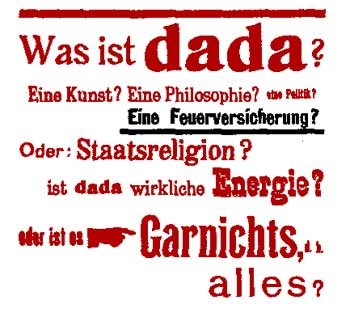
Dada- said by most to have no meaning.
This art movement was short, but significant.  The name is necessary for the artists who took part in it, even though they all wanted to reject the idea of “movements”. 

Those who began what is known today as Dada Art within the Cabaret Voltaire, Hugo Ball, Emmy Hemmings, Tristan Tzara, Marcel Janco, Arthur Segal, Jean Arp, and Richard Huelsenbeck, all came together to disrupt the art school ways.  So came about this word Dada. 

Supposedly, Huelsenbeck and Ball came upon the word in a French-German dictionary. To Ball, it fit.  As noted in Huelsenbeck’s diary, “Dada is ‘yes, yes’ in Romanian, ‘rocking horse’ and ‘hobby horse’ in French.” “For Germans it is a sign of foolish naiveté, joy in procreation, and preoccupation with the baby carriage.”   

It covered each language those joined together had known.

Although saying it was found in a dictionary rather than just a couple syllables that rolled off someone’s tongue and everyone yelled, “THAT’S IT! We should call what we are spending all our days doing Dada!”, takes away from the charm of randomness.  But we should always remember that names have purpose.